Federal wildlife service may take over Colorado wolf program due to failures and non-compliance by state officials
~Editor~
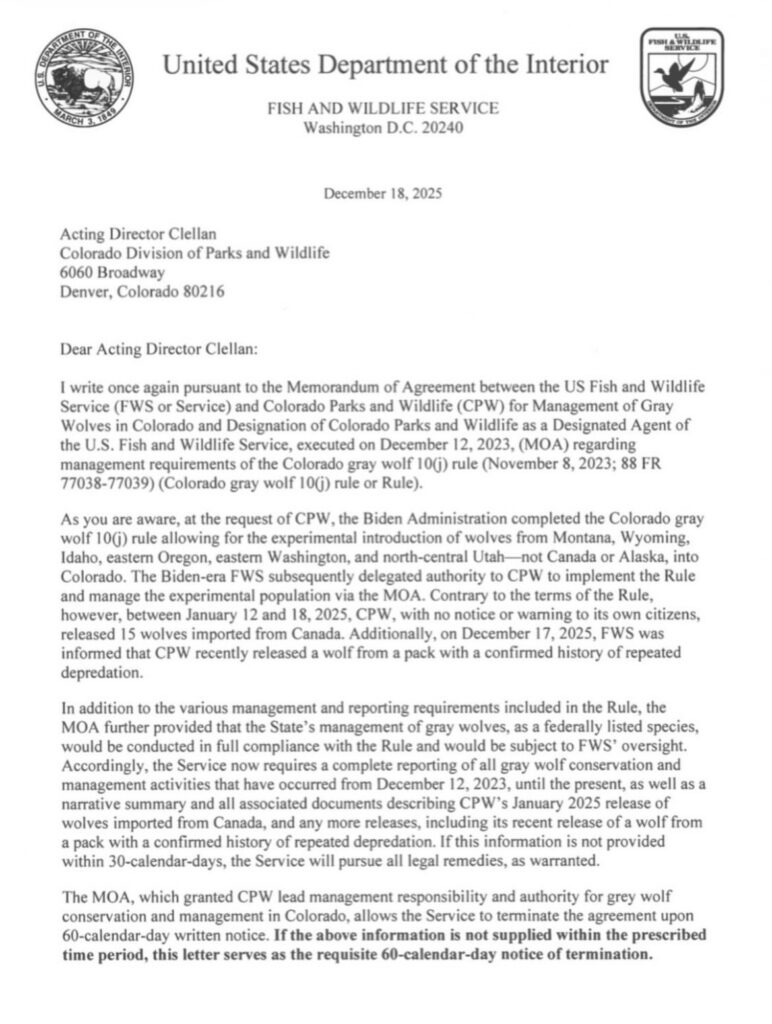
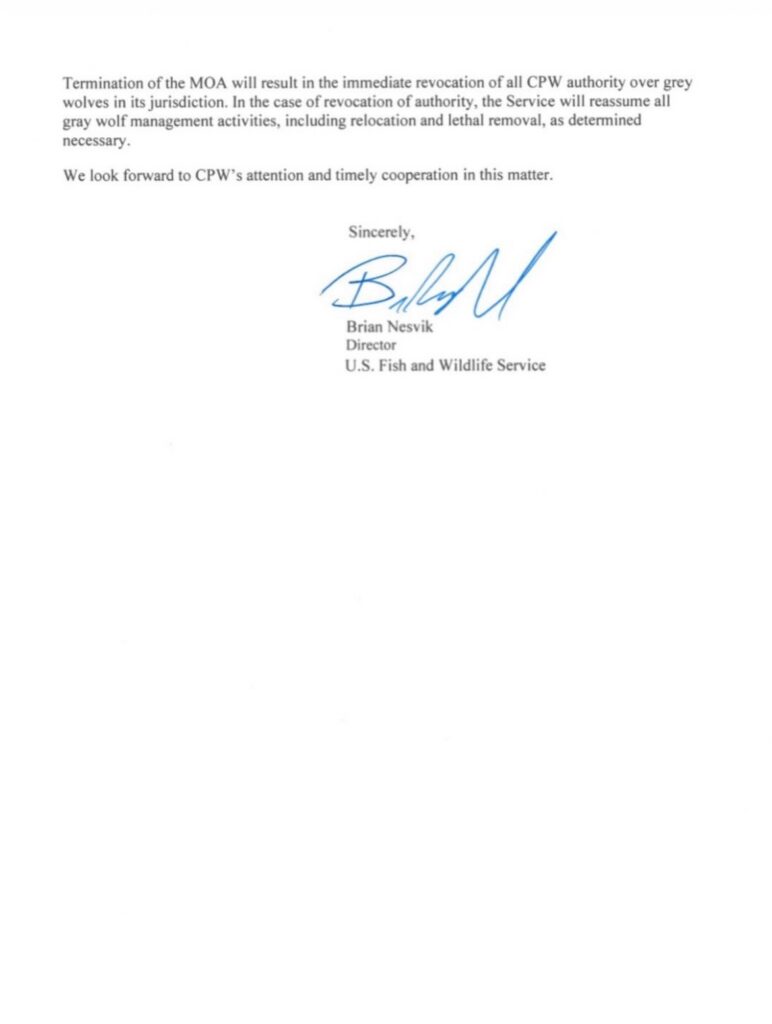
The U.S. Fish and Wildlife Service (USFWS) has issued a stern ultimatum to Colorado Parks and Wildlife (CPW), threatening to terminate a key agreement and assume full management of the state’s controversial gray wolf reintroduction program if the agency fails to address alleged violations. In a December 18, 2025, letter obtained through a public records request, USFWS Director Brian Nesvik demanded a comprehensive report on all wolf activities since the program’s inception, citing instances of noncompliance that have fueled ongoing tensions between federal oversight and state autonomy.
The letter, addressed to CPW Acting Director Lauren Clellan, highlights two primary concerns. First, it accuses CPW of releasing 15 wolves imported from British Columbia, Canada, between January 12 and 18, 2025, “with no notice or warning to its own citizens.” This action, Nesvik wrote, violated the Memorandum of Understanding (MOU) established under the federal 10(j) experimental population rule, which restricts wolf sourcing to delisted populations in the Northern Rocky Mountains, such as Idaho, Montana, and Wyoming.
Second, the letter points to the recent release of a yearling wolf, identified as 2403 from the Copper Creek pack, which has a confirmed history of livestock depredation. Nesvik noted this was the second time the wolf had been released, emphasizing that such actions contravene guidelines designed to minimize conflicts with ranchers.
CPW has been given 60 days—until mid-February 2026—to submit a detailed narrative summary and supporting documents covering activities from December 12, 2023, when the first wolves were released, to the present. Failure to comply, the letter warns, will result in the termination of the MOU, allowing USFWS to take over decisions on wolf relocation, lethal removals, and other management aspects.
In a statement, CPW disputed the allegations, asserting it has “coordinated with USFWS throughout its gray wolf reintroduction effort and has complied with guidance from USFWS as well as all applicable federal and state laws.”
This federal intervention marks the latest escalation in a program born from Proposition 114, a 2020 voter initiative that narrowly passed with 50.9% approval, forcing non-native gray wolves into rural counties. The state, which had been wolf-free since the 1940s due to eradication efforts, began releases in late 2023 with animals from Oregon. However, sourcing challenges quickly emerged. Idaho, Montana, and Wyoming refused to provide wolves in 2023, prompting CPW to source large timber wolves from Canada and Alaska—moves that drew federal scrutiny.
Prior reporting has chronicled these noncompliance issues throughout 2025. In October, USFWS explicitly barred further imports from Canada and Alaska, reiterating that wolves must originate from the Northern Rocky Mountain population to align with the 10(j) rule, which designates the animals as a nonessential experimental population with flexible management options.
Earlier, in July, state lawmakers grilled CPW officials during a legislative hearing on the program’s troubles, including rising depredation incidents. Between April 2024 and April 2025, according to CPW’s annual report, wolves were confirmed to have killed at least 25 cattle and sheep, with up to six times that number being unconfirmed, lost or unreported.
The program has been an ecological debacle from the start and its impacts on ranchers and livestock have been a flashpoint. In 2025, ranchers filed compensation claims totaling $580,000 with CPW for wolf-related losses, reflecting heightened conflicts in areas like Grand, Jackson, and Routt counties.
Specific incidents include the lethal removal of a gray wolf in May 2025 after it injured a cow and calf, part of a chronic depredation pattern by the Copper Creek pack. Other reported incidents include:
- September 2023: Relocation of Copper Creek Pack (Grand County)
CPW captured the entire Copper Creek pack (six wolves: adult male, adult female, and four yearlings) due to multiple confirmed livestock depredations (primarily calves and cattle) in Grand County. The pack was held in captivity for several months before relocation. Reason: Chronic depredation with repeated attacks. Outcome: Successful capture and temporary removal from the wild; pack was rereleased in Pitkin County in January 2025. During the process, the adult male died from a prior gunshot wound (not intentional by CPW). - May 29, 2025: Lethal Removal of Wolf 2405 (Pitkin County)
CPW lethally removed gray wolf 2405 (a yearling from the Copper Creek pack) after confirming four depredation events between May 17 and May 25, 2025, including injuries and killings of calves and a cow. Reason: Chronic depredation despite producers’ use of non-lethal measures (e.g., turbo fladry, fox lights, noise makers, increased human presence, carcass removal). Outcome: Successful kill; CPW monitored the pack afterward to assess behavioral changes. - July 20, 2025 (Ongoing): Attempted Lethal Removal of Additional Copper Creek Pack Wolf (Pitkin County)
CPW initiated efforts to lethally remove at least one more wolf from the Copper Creek pack following a confirmed depredation on July 18, 2025 (a calf kill). Reason: Repeated livestock killings by the pack, meeting chronic depredation criteria (three or more incidents in 30 days). Outcome: Unsuccessful as of late 2025 reports; efforts continued for several days but were hampered by challenging terrain, and no kill was confirmed. CPW denied requests to remove the entire pack but indicated potential for additional removals if needed. - August 16–22, 2025: Attempted Lethal Removal of Uncollared Wolf (Rio Blanco County)
CPW, with USDA Wildlife Services, deployed a team to lethally remove an uncollared wolf responsible for six confirmed depredations (primarily sheep) in late July and August 2025. Reason: Chronic depredation, with incidents confirmed by evidence (three by clear and convincing standard). Efforts were delayed by the Elk Fire. Outcome: Unsuccessful; after six days of searching, the team discontinued without killing the wolf. No further depredations reported in the area since August 16.
According to CPW, ranchers report increased stress and operational costs, such as hiring range riders and installing fladry (flagging) to deter predators. One ranch in northern Colorado noted its livestock death loss creating emotional and financial burdens which are putting some ranchers on the edge of failure.
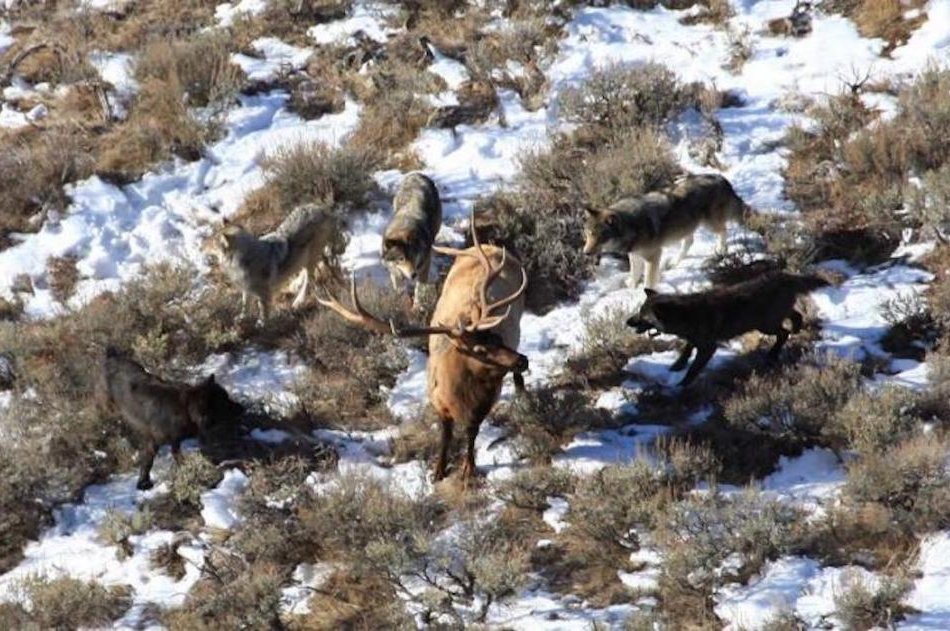
Beyond livestock, wolves’ reintroduction has sparked debates over effects on big game species, particularly elk and deer, which form the predators’ primary prey. CPW’s 2024-2025 wolf status report documented instances of wolves preying on elk calves and adults, with packs like the North Park group confirmed in numerous depredations.
Hunters and wildlife advocates express concerns that unchecked wolf growth could depress big game numbers in localized areas, similar to patterns in Yellowstone post-reintroduction, where elk herds declined and moose were decimated.
With no plans for additional releases in 2026, Colorado’s failed wolf program hinges on CPW’s response.
Screenshots of the letter follow: